
 Charlotte Campbell
Key Insights
| Data from Zillow reveals that monthly rental prices in Halifax as of July 2025 were at $2,155, which is down 13.6% from the previous year. Immigration News Canada illustrates how rent in Nova Scotia is among the top three most expensive provinces in the country, with an average monthly rent of $2,088 in 2025. According to the Rental Market Trends Report in Halifax, the average rent across all apartment types in Halifax as of July 2025 was $1,772 per month. The Halifax Partnership reveals that from 2015 to 2024, the average monthly rent in Halifax has increased by 67.6%. Based on data from the Canadian Centre for Housing Rights in 2024, many tenants have experienced steep monthly rent hikes, going as high as $600. |
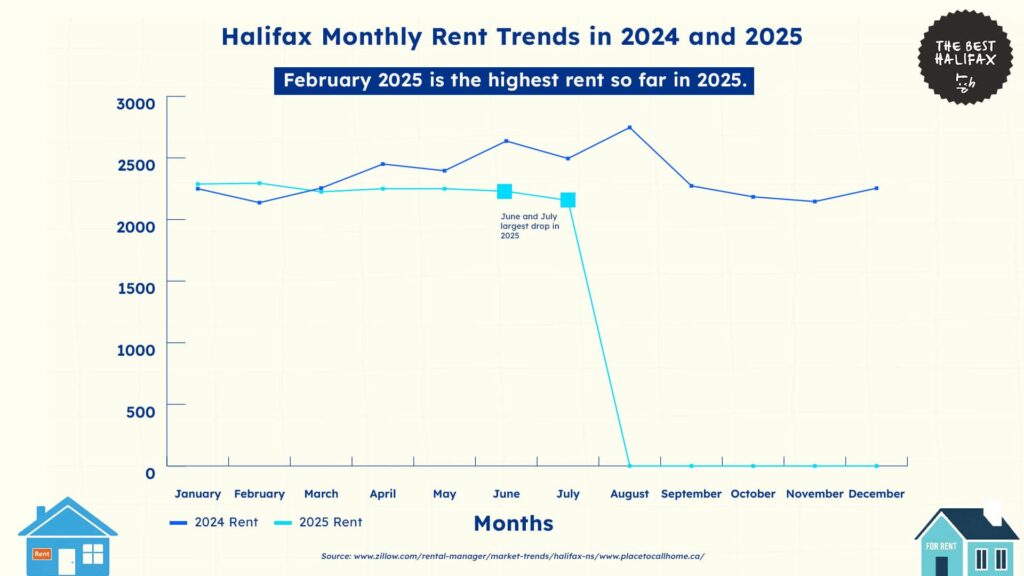
Recent reports from Zillow show that rental prices in Halifax during 2025 have shown a mix of ups and downs compared to 2024.
In January 2025, the average rent was $2,288, which is a 1.7% increase from $2,250 in January 2024. This small rise suggests that rent prices were still fairly stable at the beginning of the year.
February saw a bigger jump. The average rent climbed to $2,295, which is 7.4% higher than the $2,137 recorded in February 2024.
That was the biggest yearly increase so far for 2025, possibly because more people were moving or fewer units were available. As a result, landlords were able to charge higher rates.
However, these trends started to shift in March. The average rent dropped slightly to $2,225, down 1.3% from $2,255 in March 2024.
While this was not a large drop, the figure still showed that rent increases were not continuing to rise like they did earlier in the year.
The following month, in April, rent stayed at $2,250. Following the decreasing pattern, this was 8.2% less than April 2024, when the average was $2,450.
Possible explanations for this could be that landlords were adjusting prices to attract more tenants or that renters were no longer willing to pay as much as they did the year before.
In May, the average stayed the same at $2,250, but this was also 6.1% lower than the $2,396 from May 2024.
June experienced the biggest yearly change. Rent dropped to $2,229, which is 15.5% lower than the $2,637 average in June 2024.
Considering that this time of the year often experiences stronger rental demands, this is a fairly large decrease. The drop here further shows that landlords had to lower prices based on changing trends.
Moreover, July saw a continuation of this pattern. The average rent was $2,155, which is 13.6% lower than the $2,495 seen in July 2024.
Overall, rental prices in Halifax went up a bit at the start of 2025 but started dropping by March. By summer, the drop became more noticeable, especially when compared to 2024.
Regional Analysis of Rental Prices Across Canadian Provinces
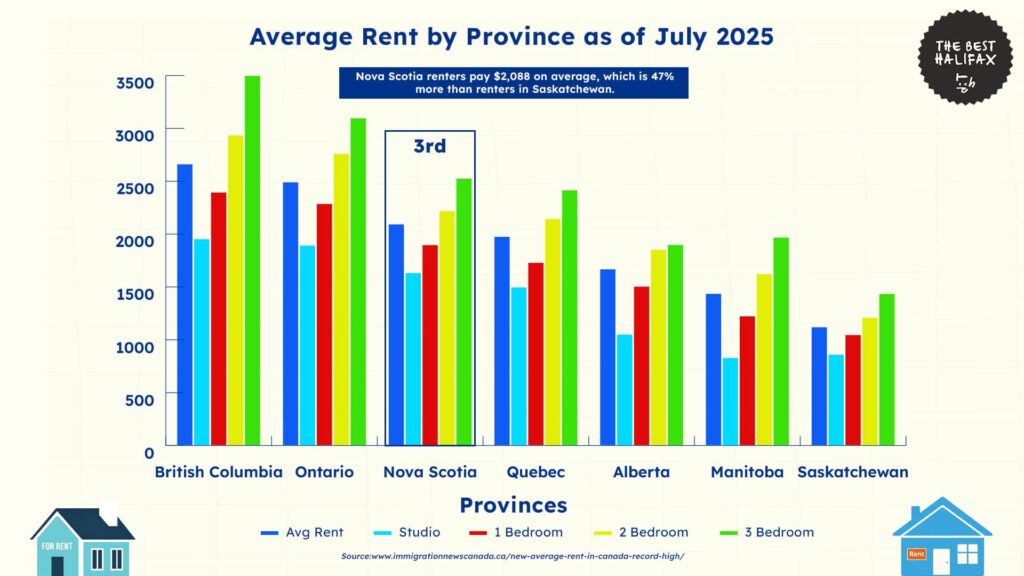
Immigration News Canada shows that as of July 2025, the average rent in Nova Scotia reached $2,088 per month, placing it among the three most expensive provinces in Canada for renters.
Only British Columbia and Ontario recorded higher average rental costs.
In British Columbia, the average monthly rent was $2,656, or 27% higher than in Nova Scotia. The substantial difference highlights the elevated cost of living in cities such as Vancouver, where housing demand remains high.
Similarly, Ontario reported an average rent of $2,486, which is 19% more than Nova Scotia. Rental pressure in metropolitan areas like Toronto continues to drive these higher rates.
Meanwhile, Quebec offered slightly more affordable housing, with an average rent of $1,970, or 6% lower than in Nova Scotia.
In Alberta, the average rent stood at $1,663, making it 20% lower than in Nova Scotia. Despite strong urban populations in the province, rents have remained relatively lower in comparison.
Manitoba recorded an average monthly rent of $1,431, which is 31% lower than Nova Scotia. Lower population growth and less rental demand could possibly contribute to this pricing gap.
Saskatchewan reported the lowest provincial average, with rent at $1,115. Renters in Nova Scotia, therefore, pay 47% more than those in Saskatchewan.
When broken down by unit type, Nova Scotia continues to rank near the top, with consistently higher prices than most provinces outside British Columbia and Ontario.
Studio apartments in Nova Scotia averaged $1,628 per month. While lower than British Columbia at $1,948 and Ontario at $1,887, this figure was significantly higher than Alberta at $1,046, Manitoba at $824, and Saskatchewan at $855.
Nova Scotia’s studio rent was also 56% higher than in Alberta and 96% higher than in Manitoba.
Meanwhile, one-bedroom apartments in Nova Scotia averaged $1,892. This was 21% lower than British Columbia at $2,389, and 17% lower than Ontario at $2,281.
However, compared to Alberta at $1,499, the cost was 26% higher. Rents were also 56% higher than in Manitoba and 82% higher than in Saskatchewan.
Two-bedroom units in Nova Scotia were priced at $2,213, ranking third behind British Columbia at $2,930 and Ontario at $2,755.
Compared to Alberta at $1,848, Manitoba at $1,618, and Saskatchewan at $1,205, the differences reached 20%, 37%, and 84% respectively.
Three-bedroom units in Nova Scotia averaged $2,521, once again ranking third nationally. The cost was 28% lower than British Columbia at $3,493, and 18% lower than Ontario at $3,091.
Conversely, the figure was 33% higher than Alberta, 28% higher than Manitoba, and 76% higher than Saskatchewan.
Across all apartment sizes, Nova Scotia consistently recorded the third-highest rent levels in Canada.
While more affordable than British Columbia and Ontario, it remains significantly more expensive than provinces in central and western Canada.
Rental Trends in Halifax
Average Rental Prices for Apartments and Townhomes
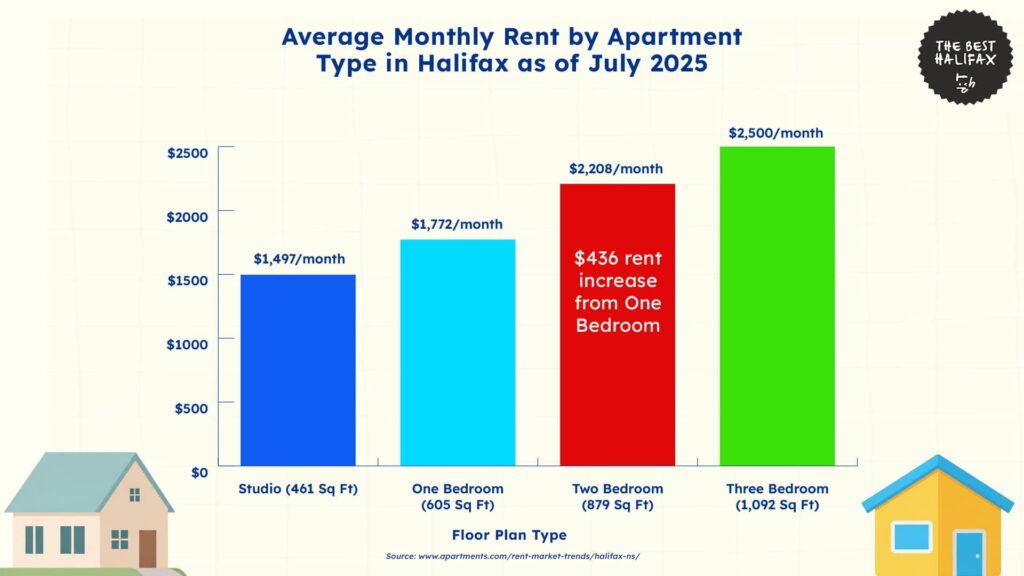
Data from the Rental Market Trends Report in Halifax shows that the average rent across all apartment types in Halifax was $1,772 per month as of July 2025.
This figure is a 0.2% decrease compared to July 2024. While the drop is small, it suggests that rental prices may be stabilizing or slightly cooling after rising in previous years.
The average size of an apartment in the city is 605 square feet, which gives a rough estimate of $2.93 per square foot.
Studio apartments are the most affordable option in Halifax. These units cost an average of $1,497 per month and are about 461 square feet in size.
That’s about $275 less per month than a one-bedroom apartment, but it also comes with 144 fewer square feet of space.
One-bedroom apartments have an average rent of $1,772 per month, which matches the overall city average, which is also $1,772.
The typical size for a one-bedroom is 605 square feet, which is enough space for one or two people. This makes them a popular choice for singles, couples, or small households.
Two-bedroom apartments are more expensive, with an average rent of $2,208. These units offer around 879 square feet, which is 274 square feet more than a one-bedroom.
The price difference is $436, meaning renters are paying about $1.59 for every extra square foot.
Three-bedroom apartments are the most costly. They rent for $2,500 per month on average and are 1,092 square feet in size.
When comparing across unit sizes, the cost increases significantly with each additional bedroom. However, the amount of extra space gained doesn’t always match the amount of extra money paid.
Alongside apartments, townhomes also make up a portion of Halifax’s rental market.
These units typically offer more space and privacy than standard apartments and are often preferred by small families or tenants looking for multi-level layouts.
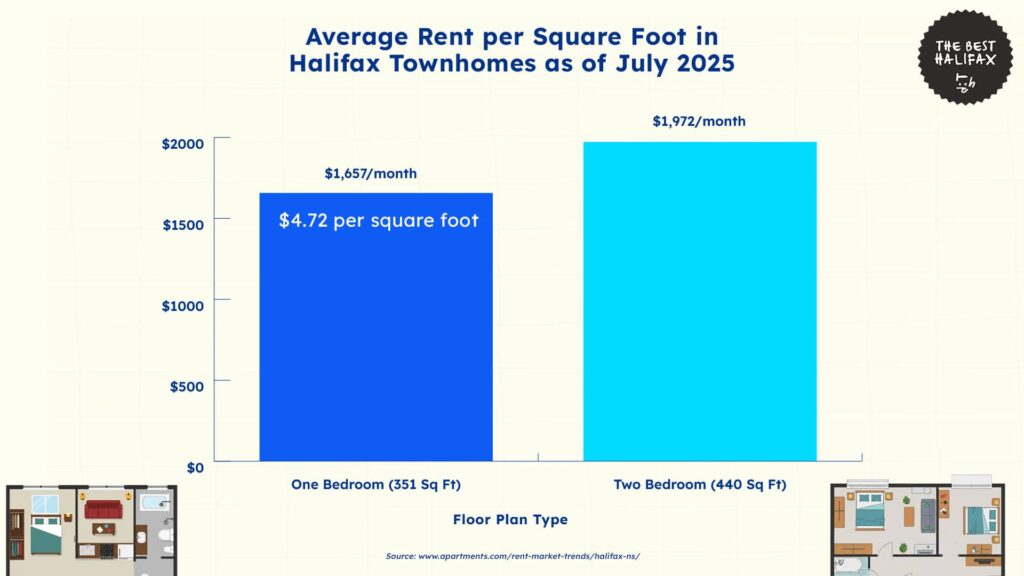
One-bedroom townhomes had an average rent of $1,657 per month in July 2025. These homes are relatively compact, with an average size of 351 square feet.
Compared to one-bedroom apartments, which averaged $1,772 for 605 square feet, townhomes cost $115 less per month but also come with 254 fewer square feet.
Two-bedroom townhomes are rented for $1,972 per month, with an average size of 440 square feet.
Notably, this is $236 less than the $2,208 average for two-bedroom apartments. However, again, the size difference is significant.
Apartment-style two-bedrooms offer 879 square feet, while townhomes in this category offer just 440 square feet.
In terms of rent per square foot, one-bedroom townhomes cost around $4.72, while two-bedroom townhomes cost roughly $4.48.
Both rates are higher than the citywide apartment average of $2.93 per square foot, showing that while the rent is lower overall, the smaller size means you’re paying more for each square foot of space.
These higher per-square-foot costs suggest that renters choosing townhomes may be paying for other features like private entrances, patios, or location benefits.
Residential Rent Prices and Vacancy Rates
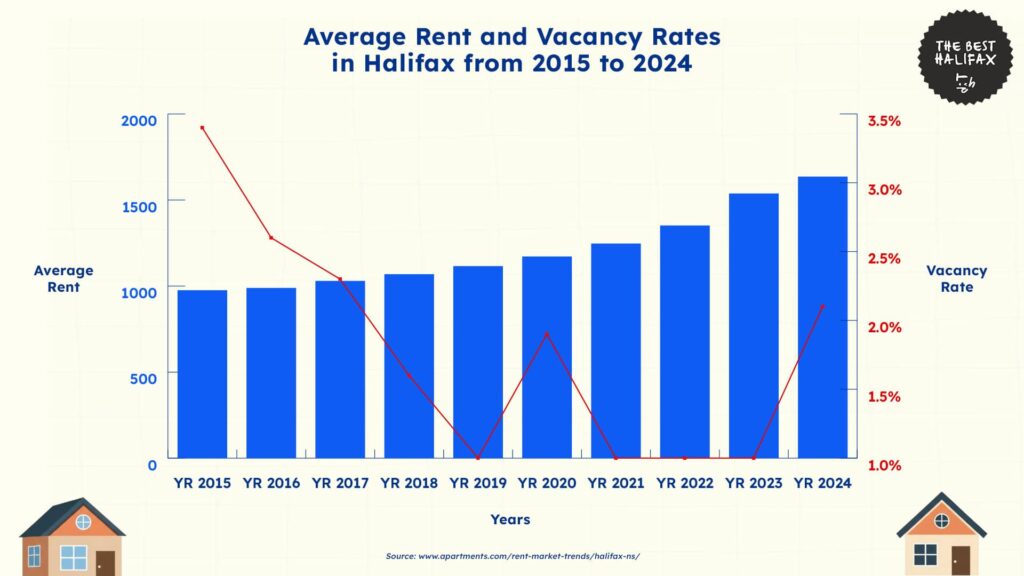
The Halifax Partnership illustrates how rental market conditions in the city have shifted significantly over the past decade.
While average rent has increased year after year, vacancy rates have generally declined, pointing to sustained pressure on housing supply and affordability.
In 2015, the average rent in Halifax was $976 per month, and the vacancy rate was 3.4%.
A vacancy rate this high indicated a relatively balanced market, where rental supply was sufficient to meet demand. Renters had more flexibility in choosing units, and landlords had less leverage to raise prices.
The next year, 2016, brought some changes. Average rent rose slightly to $989, an increase of 1.3%, while the vacancy rate fell to 2.6%, a decrease of 0.8 percentage points.
Fewer unoccupied units suggested that demand had started to catch up with the available supply.
By 2017, the rental market continued the same pattern. Rent reached $1,030, which is a 4.1% increase, while the vacancy rate dropped further to 2.3%.
This decline of 0.3 percentage points in availability coincided with a $41 increase in rent, showing that lower vacancy was beginning to drive prices upward.
Further changes occurred in 2018. Average rent rose to $1,069 per month, reflecting a 3.8% increase, and the vacancy rate declined again to 1.6%, a decrease of 0.7 percentage points.
Pressure on the rental market intensified as landlords had fewer units to lease and could charge more for those that remained.
Notably, in 2019, the vacancy rate fell to 1.0%, a drop of 0.6 percentage points, meaning only 1 out of every 100 rental units was unoccupied.
At the same time, average rent increased to $1,116. This 4.4% increase shows that low housing supplies continued to burden renters.
Conditions briefly shifted in 2020. Rent increased to $1,172, a 5.0% rise, while the vacancy rate rose to 1.9%, marking an increase of 0.9 percentage points.
The short-term boost in availability may have reflected broader economic uncertainty and mobility restrictions caused by the COVID-19 pandemic.
In 2021, the vacancy rate returned to 1.0%, A decrease of 0.9 percentage points, erasing the previous year’s increase.
At the same time, rent climbed again to $1,247, a 6.4% increase. With fewer units available and prices increasing, pressure on renters intensified, especially for those entering the market again after the pandemic’s onset
Rental prices continued their upward trajectory in 2022. Average rent increased to $1,352, a rise of 8.4%, while the vacancy rate remained unchanged at 1.0%.
This pattern persisted in 2023. Monthly rent climbed to $1,538, representing a 13.7% increase over the previous year.
Despite this sharp rise, the vacancy rate did not improve and remained fixed at 1.0%, confirming that the new supply had not kept pace with population growth or housing demand.
In 2024, Halifax recorded its highest rent level of the decade at $1,636 per month, a further 6.4% increase from 2023.
Meanwhile, the vacancy rate rose modestly to 2.1%, marking an increase of 1.1 percentage points. Although slightly more units became available, rents continued to rise, reflecting the ongoing imbalance between supply and demand.
From 2015 to 2024, the average rent in Halifax increased by 67.6%, growing from $976 to $1,636.
At the same time, the vacancy rate fell by 1.3 percentage points, dropping from 3.4% to 2.1%.
Although availability improved marginally in the most recent year, the broader trend points to a decade of steadily tightening conditions, where higher rents have become the norm and vacancy rates have remained historically low.
Costs and Consequences of Rising Rent Prices in Halifax
The Canadian Centre for Housing Rights explains how renters in Halifax continue to face increasing economic pressure as monthly rent prices rise faster than incomes.
In 2024, the average rent in Halifax reached $1,636, up 6.4% from $1,538 in 2023. Compared to 2015, when the average rent was just $976, this reflects a 67.6% increase over 10 years.
Throughout that time, vacancy rates remained critically low, hovering around 1.0% from 2019 to 2023 before rising slightly to 2.1% in 2024.
Renters have few options when faced with increases. A 1% vacancy rate leaves minimal room to negotiate or relocate.
Even with a slight increase in vacancy, the supply still fails to meet demand. Without enough completed units, renters compete for limited space, keeping prices high and choices limited.
Many tenants have reported receiving steep rent hikes that place them in vulnerable situations. One 68-year-old woman shared that her rent increased by $400 per month, leaving her and her husband with only $35 after bills.
Another renter reported a $350 increase, while a neighbor in the same building saw their rent jump by 50%.
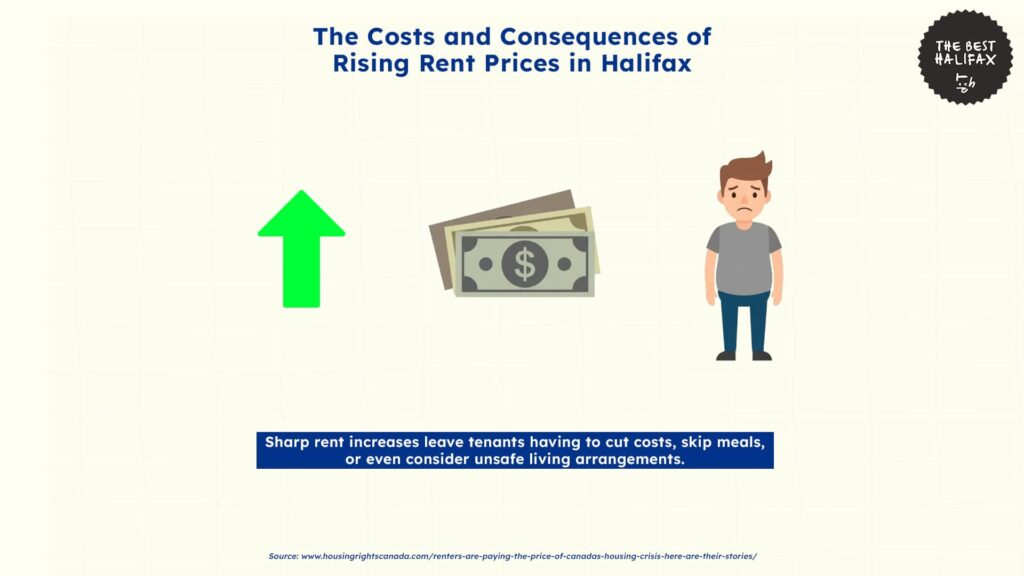
These sharp increases, especially in provinces without strong rent control, leave tenants having to cut costs, skip meals, or even consider unsafe living arrangements.
Even in provinces where rent is regulated, loopholes allow landlords to bypass restrictions.
One tenant reported experiencing a rent increase due to a legal exemption based on when the unit was first rented.
In Nova Scotia, which has a temporary rent cap, some tenants still face sudden eviction or lease non-renewal. One Dartmouth resident said she questioned a $400–$600 price hike, only to receive an eviction notice a week later.
Other tenants also reported that their landlords rushed to raise rents before the new Residential Tenancy Act capped increases. This trend shows that regulations alone are not enough without enforcement and tenant protections between leases.
In areas where housing remains unaffordable, tenants are forced to accept unsafe conditions. Many renters live in homes that either need major repairs or are overcrowded.
Others report that they live in homes that are damaged, too small, or poorly maintained, with reports of black mold, crumbling walls, and broken windows.
Halifax renters may face similar conditions, particularly in aging or poorly maintained units where demand still outpaces supply.
Vulnerable populations face the most severe consequences. One blind senior was nearly forced to use all of his savings after a $630 rent hike, while a disabled single mother struggled to afford rent after a $300 increase.
Another elderly woman said she may have to return to work despite being over 70 because her fixed income could no longer cover rent.
While these stories come from across Canada, they still mirror the reality in Halifax.
Without stronger protections, many Halifax renters, especially seniors, low-income earners, and persons with disabilities, remain at risk of financial insecurity, displacement, or homelessness.
Local housing supply is still failing to meet population growth, and even small increases in vacancy or construction are not enough to offset the cost burden that many now face.
Interventions and Solutions to Rising Rental Prices in Halifax
The Government of Halifax has expanded its response to the housing crisis by introducing multiple initiatives designed to reduce costs for developers and increase the supply of affordable homes.
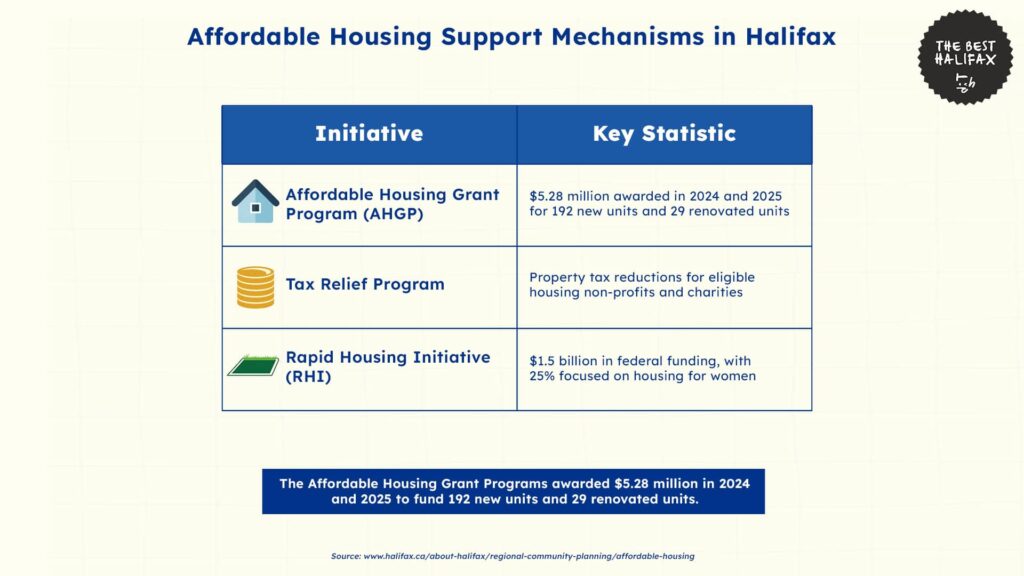
The Affordable Housing Grant Program (AHGP) serves as a major funding source, distributing $5,275,718 to 10 projects for the 2024–2025 cycle.
These grants supported the development of 192 new affordable housing units and helped renovate or repair an additional 29 units.
Among the largest recipients were YWCA Halifax, which received $2,270,000 to build 64 townhouses in Dartmouth, and the Mi’kmaw Native Friendship Centre.
Other beneficiaries included Affirmative Ventures with $353,400 for a 30-unit townhouse project, Shelter Nova Scotia with $1,100,000 for a 21-unit housing project, and Adsum for Women and Children with $268,673 for the renovation of a 4-unit rental building.
Additional grants between $20,000 and $270,000 supported smaller projects led by co-operatives and non-profit organizations across Halifax, Lake Loon, and Westphal.
To further support affordability, Halifax offers tax relief through its Tax Relief for Non-Profit Organizations Program, allowing eligible housing providers to reduce annual property taxes.
This multi-year tax benefit ensures longer-term financial stability, especially for smaller non-profits.
Since November 2020, the municipality has also waived most construction-related fees for housing developments led by non-profit and charitable organizations.
A measure like this eliminates upfront development costs that can otherwise delay or derail affordable housing projects.
Alongside this, Halifax Water allows Regional Development Charges (RDCs) to be deferred for up to 10 years, easing financial pressure during the early stages of project development.
Access to land has also been addressed through a surplus land policy approved in December 2020.
Municipal lands have been reclassified to prioritize affordable housing, with the first batch of sites expected for release in 2025 through a public call for proposals.
Planning for this program is currently underway through the Housing Accelerator Fund, which aims to ensure a fair and transparent site disposal process.
At the federal and national levels, the Rapid Housing Initiative (RHI) has provided further support through the Cities Stream, which Halifax has joined for three rounds.
Launched under the National Housing Strategy, the RHI focuses on urgent housing needs and has allocated $1.5 billion nationwide, including $500 million for cities.
The initiative targets vulnerable populations and directs at least 25% of investments toward women-focused housing.
Altogether, these interventions reflect a coordinated effort to increase housing supply, reduce development barriers, and support long-term affordability across the city.
The Future of Rental Prices in Halifax
Rental affordability in Halifax is expected to remain a key concern through the next several years.
Between 2015 and 2024, rents rose by 68%, increasing from $976 to $1,636. If similar yearly increases of around 5% continue, monthly rents could reach approximately $1,820 by mid-2026 and may climb to $1,940 by 2028.
This would represent a further 10% increase from current rates, creating even more issues of affordability for many residents.
Moreover, affordable and low-income housing options remain insufficient to meet current supply demands.
Unless new options begin to match or exceed demands, the overall housing supply will continue to lag, leaving renters with limited choices that create more upward pressure on prices.
Government interventions such as the Affordable Housing Grant Program and the Rapid Housing Initiative aim to address these imbalances.
From 2024 to 2025, the AHGP funded several projects that will produce 192 new units and repair 29 more.
Similarly, federal RHI funding under Budget 2022 allocated $1.5 billion to deliver 4,500 new affordable units nationwide, with at least 25% earmarked for women-focused housing.
Along with this, policy changes like the planned 2025 release of surplus land and continued tax relief for non-profit housing developers may also improve conditions in the long run.
However, unless these initiatives are scaled up significantly, affordability will continue to be an issue, especially for renters without income support.
Vulnerable groups, including seniors and low-wage earners, will likely face the harshest impacts of price hikes and limited supply, particularly in the absence of provincial rent regulations.
Overall, rent increases, low vacancy rates, and limited housing options suggest that affordability in Halifax is unlikely to improve without stronger, faster, and larger-scale interventions.
References
- Zillow. (2025). Halifax, NS rental market trends. Zillow Rental Manager. https://www.zillow.com/rental-manager/market-trends/halifax-ns/
- Immigration News Canada. (2024, June 12). New average rent in Canada hits record high in 2024. https://immigrationnewscanada.ca/new-average-rent-in-canada-record-high/
- Apartments.com. (2025). Halifax, NS rent market trends. https://www.apartments.com/rent-market-trends/halifax-ns/
- Halifax Partnership. (2024). Halifax Index: Real estate. https://halifaxpartnership.com/research-strategy/halifax-index/real-estate/
- Housing Rights Canada. (2024, May 27). Renters are paying the price of Canada’s housing crisis: Here are their stories. https://housingrightscanada.com/renters-are-paying-the-price-of-canadas-housing-crisis-here-are-their-stories/
- Halifax Regional Municipality. (2024a). Affordable housing. https://www.halifax.ca/about-halifax/regional-community-planning/affordable-housing
- Halifax Regional Municipality. (2024b). Affordable Housing Grant Program. https://www.halifax.ca/about-halifax/regional-community-planning/affordable-housing/affordable-housing-grant-program
- Halifax Regional Municipality. (2024c). Tax relief for non-profit organizations. https://www.halifax.ca/business/doing-business-halifax/tax-relief-non-profit-organizations
- Halifax Water. (2024). Regional Development Charge. https://halifaxwater.ca/regional-development-charge
- Halifax Regional Municipality. (2024d). Housing Accelerator Fund. http://halifax.ca/haf
- Canada Mortgage and Housing Corporation. (2024). Rapid Housing Initiative. https://www.cmhc-schl.gc.ca/professionals/project-funding-and-mortgage-financing/funding-programs/all-funding-programs/rapid-housing